What International Buyers Need to Know
Demand for A2-tested dairy cattle is growing across the Gulf and South-East Asia. The Asia Pacific A2 milk market alone is projected to grow from USD 2.21 billion in 2024 to USD 10.59 billion by 2033. That’s a CAGR of 19.02% (Market Data Forecast, 2024), while the Middle East is seeing steady growth driven by rising health awareness and government food security programs.
For buyers sourcing A2 cows — whether Holstein Friesian, Jersey, or Guernsey — from Australia, understanding A2 beta-casein genetics before purchase is now a standard part of due diligence.
This article covers what A2 genetics are, how they differ by breed, and why international buyers are requesting A2-tested cattle.
What Is A2 Beta-Casein in Dairy Cattle?
Milk contains proteins called beta-caseins. There are two main variants: A1 and A2. All dairy cattle carry two copies of the beta-casein gene — one inherited from each parent — meaning an animal is either A1/A1, A1/A2, or A2/A2.
Only A2/A2 animals produce milk containing exclusively A2 beta-casein. A1/A2 animals produce a mixture of both. A1/A1 animals produce no A2 milk. An animal’s status cannot be determined by breed or appearance — it must be confirmed through genetic testing of the CSN2 gene.
A2 milk is now a premium product category commanding higher retail prices across the Middle East, South-East Asia, and beyond.
A2 Genetics by Breed
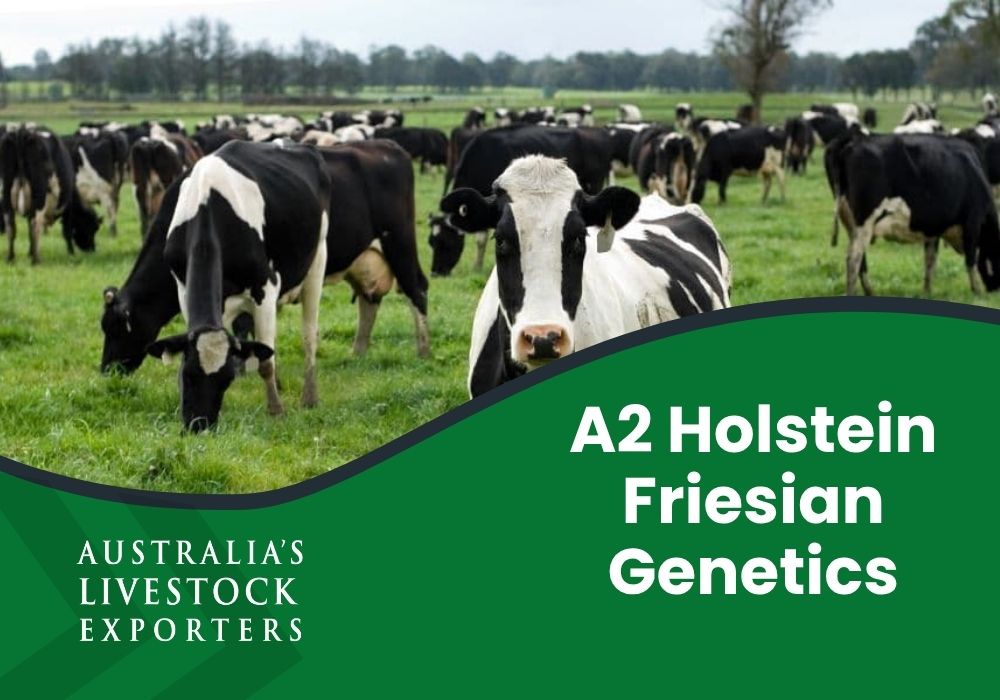
هولشتاين فريزيان is the world’s most productive dairy breed and the most commonly exported dairy cow from Australia. However, not all Holsteins carry A2/A2 genetics. The A1 variant spread through Holstein populations as breeding programs prioritised milk yield without A2 status as a selection criterion — meaning A1 became common without ever being deliberately selected for. A2/A2 Holstein Friesians do exist and can be specifically selected prior to export.
أبقار الجيرسي naturally carry a higher prevalence of A2 genetics than Holsteins, making them a popular choice for buyers building A2 herds from the ground up.
Guernsey cattle carry the highest natural A2 prevalence of all three breeds — with A2 allele frequencies of 88–97% recorded in research studies — making them the strongest starting point for buyers establishing a dedicated A2 herd.
Regardless of breed, genetic confirmation of individual animals remains essential before any export program targeting A2 milk production.
Why International Buyers Are Requesting A2-Tested Cattle
Food security programs
Gulf governments are investing in domestic dairy production as part of national food security strategies, increasingly specifying premium genetics — including A2 status — to maximise the commercial value of domestically produced milk.
Consumer demand
A2 milk is now widely retailed across the GCC under international brands. Importers building A2 dairy operations need confirmed A2/A2 genetics from the outset — retrofitting a herd after purchase is significantly more expensive than selecting correctly at import.
Traceability
Gulf food safety regulators and private buyers increasingly require documented genetic results as part of import compliance. An A2/A2 certificate issued prior to export satisfies this requirement and simplifies the approval process.
In South-East Asia — particularly Malaysia, Indonesia, and Vietnam — similar dynamics apply, with importers establishing new dairy operations making A2 genetics a selection priority from day one.
Arranging A2 Testing Before Export
Australia’s Livestock Exporters coordinates A2 genetic testing as part of the end-to-end export process — covering individual animals, selection groups, and entire consignments. Testing can be combined with genomic testing and integrated with veterinary, quarantine, and export documentation requirements.
For full details on the testing process, eligible breeds, and how to request testing as part of your export order, visit our A2 Livestock Testing service page.
Frequently Asked Questions
What is A2 Holstein Friesian?
An A2 Holstein Friesian is a Holstein Friesian dairy cow genetically tested and confirmed as A2/A2 — meaning it carries two copies of the A2 beta-casein gene and produces milk containing exclusively A2 beta-casein protein. A2/A2 status cannot be determined by breed or visual assessment alone; it must be confirmed through laboratory analysis of the CSN2 gene.
Do all Holstein Friesian cattle carry A2 genetics?
No. Holstein Friesian cattle can be A1/A1, A1/A2, or A2/A2 depending on their parents’ genetics. The A1 variant became widespread in Holstein populations because breeding programs historically prioritised milk yield without selecting for A2 status. A2/A2 Holsteins exist within the breed but must be individually confirmed through laboratory genetic testing of the CSN2 gene.
Which dairy breeds have the highest prevalence of A2 genetics?
Guernsey cattle carry the highest natural A2 prevalence of any major dairy breed, with A2 allele frequencies of 88–97% recorded in peer-reviewed research. Jersey cattle have the second-highest prevalence at approximately 49–72%. Holstein Friesians have a significantly lower natural A2 prevalence. Regardless of breed, laboratory testing of the CSN2 gene is required to confirm A2/A2 status in individual animals.
How is A2 testing performed and can it be arranged before export?
Yes — A2 livestock testing can be arranged during the pre-export selection phase, before cattle are shipped from Australia. The test involves collecting a tissue or hair sample from each animal, which is analysed at an accredited laboratory to identify the CSN2 gene variant and confirm whether the animal is A2/A2, A1/A2, or A1/A1. Results are provided to the buyer prior to shipment. For full details see our A2 Livestock Testing page.